Among all the chapters in The Anthropocene Reviewed, “Sycamore Trees” remains my favorite. That is saying a lot, considering the premise of the entire book is already fascinating: John Green attempts to review different facets of human life and existence through the lens of the Anthropocene, the age in which human activity has become one of the dominant forces shaping the planet.
As a longtime reader of Green’s work, though, I know that what keeps drawing me back is not the distinctiveness of the concept. It is his ability to wrestle with existence itself. Questions of meaning, mortality, and what it means to live a life worth living have always lingered in his writing. I found them in The Fault in Our Stars, Looking for Alaska, Paper Towns, and Turtles All the Way Down. Even when his stories seem to be about teenagers, friendships, or love, they are often really about how people make sense of being alive. So, it was not surprising that “Sycamore Trees” touched on those same questions.
The first time I read the chapter, I was on a bus during a company team-building trip. The timing was all wrong. I read the words, appreciated them, and moved on. I remember the chapter, but its impact never fully landed. Recently, however, I found myself rereading it in a hospital.
For the past two months, my father has been confined there following a fire accident. Thankfully, no one else was harmed, but the incident took a heavy toll on him. It complicated a list of health concerns that was already difficult to manage: diabetes, hypertension, sleep apnea, pneumonia, and the continuing worries that come with having suffered two mild strokes in the past.
To call the past two months stressful would be an understatement.
Watching my father’s hospitalization unfold has made me realize how it affects an entire family, not just him. My mother has stretched herself thin caring for him day after day. My youngest brother has stepped up in a way he never had to before to help our mother. Meanwhile, my sister is preparing for her board examinations, and I am trying to keep up with work responsibilities even as life beyond it begins to unravel.
Apparently, we’re God’s strongest soldiers, because why else would it be this intense all at once?
Faced with illness and the looming unknown, I found myself reevaluating the things I considered important—wealth, academic achievements, professional titles. It made me probe into why we seek these things and what is the point of even having them when in one single moment, death can render them insignificant. Without being aware of it, I was also playing the game of Why and What’s Even The Point, as echoed in the book. In that sense, I found myself reveling toward a kind of nihilism, much like the author himself. I, too, have entertained the idea of detachment and apathy to survive this painful life.
The thing about this game is that once my brain starts playing it, I can’t find a way to stop. Any earnest defense I try to mount is destroyed instantaneously by the searing white light, and I feel like the only way to survive life is to cultivate an ironic detachment from it. If I can’t be happy, I at least want to be cool.
If playing What’s Even The Point made me a more committed advocate for justice or environmental protection, I’d be all for it. But the white light of despair instead renders me inert and apathetic.
The image of the white light serves as an important bridge to Green’s later discussion of the sycamore trees. When Green plays this game, he finds himself unable to see the point in human endeavors. Art becomes little more than the consumption of finite resources for the sake of decoration. Gardens are merely a means of producing food to sustain bodies that will eventually decay. Even love can be reduced to an attempt to stave off loneliness. Viewed through this lens, every source of meaning begins to collapse under the weight of its own impermanence, which could be mistaken for darkness. However, Green does not describe this experience as darkness. Instead, he describes it as a frozen, blinding white light. The distinction is important. Darkness may be uncomfortable, but it does not necessarily wound us. The white light does. It overwhelms. It burns. It sears. It is like staring directly at the sun. The problem is not that there is nothing to see; it is that the search for ultimate meaning exposes too much.
When I think of the future, I start to only see the big blank space, the whyless bright terror. As for the present, it hurts. Everything hurts. The pain ripples beneath my skin, bone-shocking. What’s the point of all this pain and yearning. Why?
The essay takes a gentle turn from description to reflection when Green recounts a walk through a forested park. By this point, he has already arrived at an important realization: the truth is far more complicated than despair and hopelessness. The earlier notion that the game of Why? and What’s Even the Point? goes on forever is, in itself, a kind of lie.
The turning point comes through a conversation with his friend Amy, who tells him to simply “believe.” It is her favorite word, partly because it contains the words be and live. Green becomes even more drawn to it when he learns of its etymological roots, which suggest meanings such as “to hold dear” and “to care.”
What I find beautiful about this moment is how simple the answer is. Amy does not offer a grand philosophical argument capable of defeating emotional detachment and apathy once and for all. Instead, she simply divulged a reason to continue caring. To believe, in this sense, is not to possess certainty. It is to care and hold something dear despite the looming unknown.
For Green, the word becomes a shield to the blinding white light. It urges him to remain engaged with life rather than detach from it, to hold dear rather than dismiss, and to keep going. The metaphor being the Sycamore Trees.
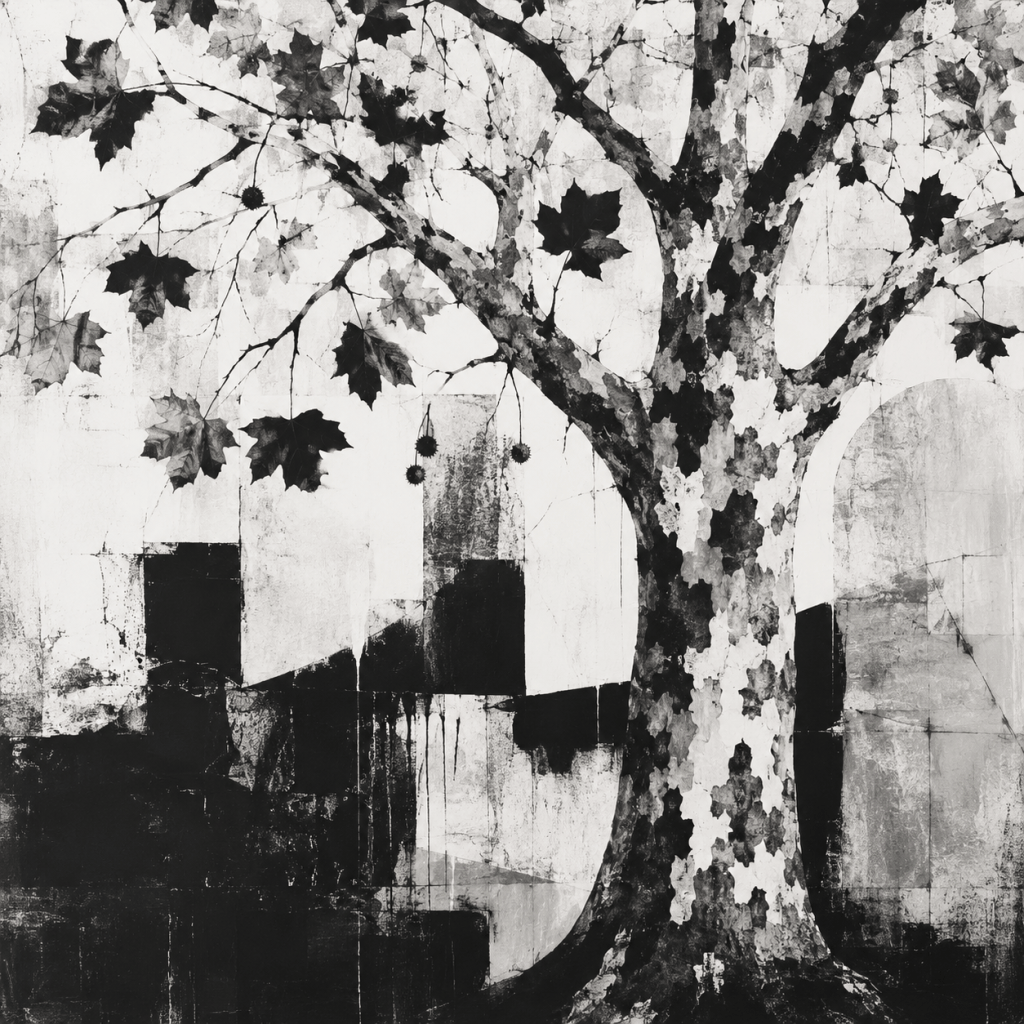
Returning to the walk through the forest with his son, Green notices an immense American sycamore tree. He is immediately struck by its scale and beauty. Later, his fascination would lead him to research the tree in depth, uncovering facts about its history, biology, and longevity. But in that moment, standing beneath its sprawling canopy, none of those details mattered.
What mattered was the feeling the tree evoked. Beneath its shade, Green experiences a sense of solace and relief, as though the sycamore’s immensity offers shelter from the sun. The white light of why’s, painful and blinding before, seems to soften under the presence of something ancient, beautiful, and alive.
Then his attention shifts. He notices his son’s thin-fingered hand reaching for his own. Pulled back from abstraction and into the immediacy of the moment, he tells him, “I love you.”
This scene made me realize that meaning was revealing itself in the very things I had overlooked. It was there in my mother showing up every day despite her fatigue. It was there in my brother stepping into responsibilities he never expected to carry. It was there in my sister continuing to review for her board exams while balancing the weight of our situation. And it was there every time I sat beside my father in his hospital room, talking about ordinary things as though ordinary life had not been interrupted. It emerges in moments of care and in simple acts of love.
It is a deceptively simple scene, yet it carries all the emotions in the essay. The answer to Why? and What’s even the point? does not arrive as a philosophical breakthrough. It arrives through presence, wonder, and love. Standing beneath the sycamore tree, Green does not solve the problem of meaning. Instead, he experiences it.
And shortly after reading the chapter, sitting in a hospital room surrounded by uncertainty, I realized that I had been experiencing it too.
Like John Green, I also give the sycamore trees five stars.


Leave a comment