Although I remember the experience quite vividly, much of the context surrounding it was later relayed to me by my parents.
It was my second time attending kindergarten. I had initially been held back from enrolling in first grade because I was considered too young, so my teachers recommended that I repeat kindergarten and proceed to elementary school the following year. This time, however, my parents decided to enroll me in a different school. Unlike my previous one, which was essentially a makeshift classroom inside a small chapel in our neighborhood, this school was considerably larger, with more students and an entirely unfamiliar environment.
I remember feeling intimidated by the sheer size of the place. The students were quite competitive, too, which was a lot to take in for a little girl who had come from a small tabernacle school. Back there, it was relatively easy to stand out and catch the teachers’ attention because there were only a handful of learners. In my new school, things were different. I struggled during my first few weeks, and I remember being particularly shy. I could perform exceptionally well in written examinations, but actively participating in class was another matter altogether. Still, I suppose my reservations didn’t keep me from finding my footing academically. I eventually emerged as the top student in my class. My teachers would later tell me that although I didn’t recite as frequently as some of my classmates, my examination scores were consistently stellar. They more than made up for my lack of classroom participation when the final grades were computed.
I don’t know the exact conversations that took place between my parents and my class adviser, but somehow, it was decided that I would deliver the graduation speech—a role traditionally reserved for the valedictorian. Although I ranked first in my own section, I wasn’t part of the school’s star section because I had enrolled late. The school’s tradition was that the valedictorian had to come from that section, which meant I couldn’t be given the title despite having the highest grades across the graduating class. I was therefore named salutatorian instead. Nevertheless, because of my academic standing, I was still given the honor of delivering the graduation speech.
My parents would proudly recount the story during family gatherings, telling my aunts and uncles that I had made history. Apparently, it was the first time something like that had happened in the school’s history. I was also the first on my father’s side of the family to receive that kind of academic recognition. It was a canon event for the clan. So, when graduation day finally came, my entire clan showed up. I remember looking out and seeing them all there, gathered to witness me deliver my speech.
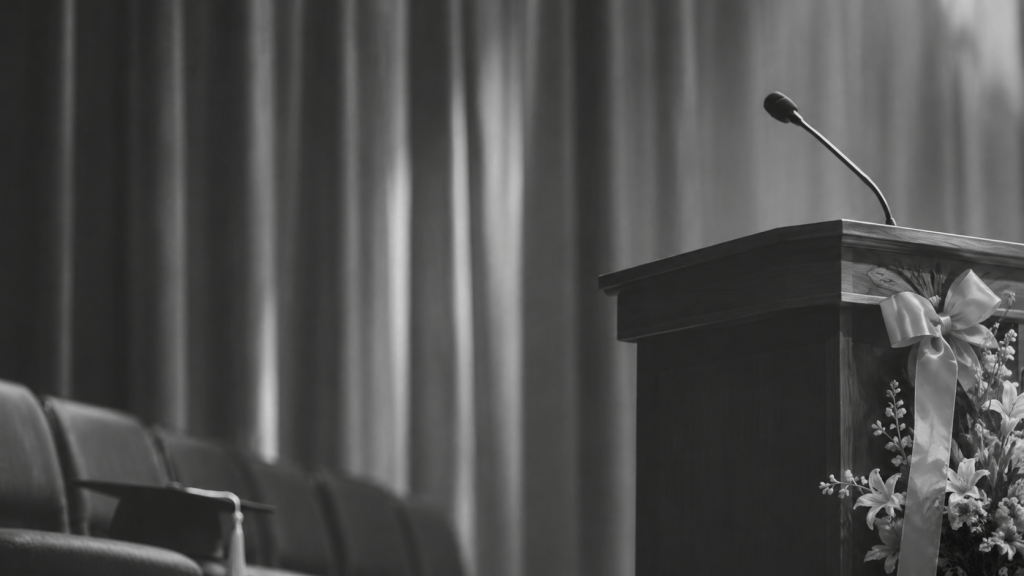
But when the moment finally arrived, everything unfolded rather differently from how I had imagined it. The moment my name was called and I was asked to make my way to the center stage, I was suddenly confronted with the enormity of the room. There were rows upon rows of students and parents filling the ceremony hall, and for a moment, it felt as though every single pair of eyes was fixed on me. I stood there, trying desperately to retrieve the first line from memory. But my mind had gone completely blank. Not a single word would come to me.
My hands were trembling. I could feel tears beginning to well up in my eyes. I tried to speak, but all that came out were stammered words. I remember desperately trying to gather myself, to remember something—anything—from the speech I had probably rehearsed countless times. But the more I tried, the more everything seemed to slip away.
And then I saw my mother. She had rushed from her seat to stand directly in my line of sight, mouthing the opening words of my speech. But seeing her only made me cry harder. Whatever composure I had left completely fell apart. It was all so dramatic. I abandoned the speech, ran straight to her, and buried myself in her arms. I remember hearing the emcee announce that the speech would be delivered later as they moved on to the next segment. My classmates watched, seemingly unsure of how to react, while I caught a glimpse of disappointment on my adviser’s face. I couldn’t blame anyone. It was just all too much for a little girl standing in front of an entire hall, expected to deliver a speech she could no longer remember.
It was, unbeknownst to me then, only the beginning of a long history of being crippled by stage fright, particularly in moments when all eyes were on me.
For years, stage fright followed me into classrooms, competitions, presentations, and eventually, even professional settings. But somewhere along the way, I grew tired of letting fear dictate what I could and couldn’t do. So, I worked at it. I volunteered for speaking opportunities, forced myself to participate, and learned to sit with the discomfort of being seen and heard. It wasn’t an overnight transformation, nor did the nerves ever completely disappear. But eventually, I learned that courage wasn’t necessarily the absence of fear. Sometimes, it was simply learning to speak despite it.
However, the real full circle moment came years later, when I found myself working as an English instructor to other Asian students. There I was, the same girl who once couldn’t get a single word out in front of an audience, speaking for a living. I remember one particular piece of advice from our training that stayed with me: whenever I spoke, I had to imagine that I was the one in control of the room. Somehow, that simple shift in perspective changed things for me. I became less conscious of the eyes watching me, more comfortable with my own voice, and eventually learned to loosen up whenever I spoke in front of others. I don’t think I ever completely outgrew the nerves, but I learned not to let them get in the way.
I wonder what that little girl would have thought if she could have seen me then.




Leave a Reply